
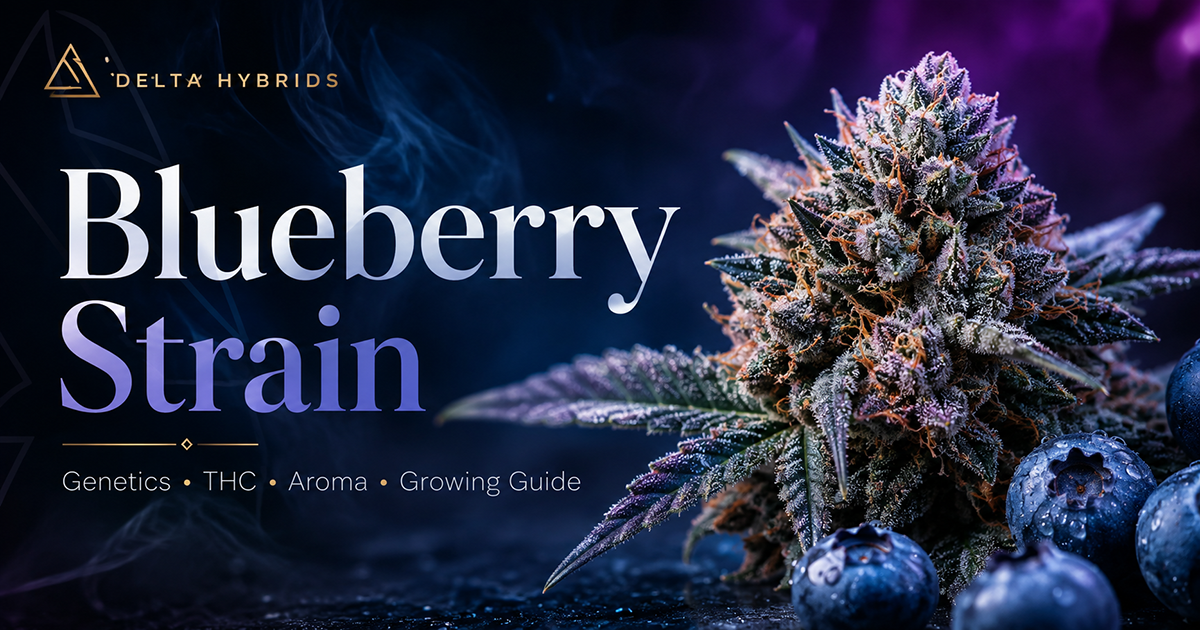
Blueberry Strain: Genetics, THC, Aroma & Growing Guide
Blueberry is one of the foundational names in modern cannabis breeding. Developed by breeder DJ Short from work dating to the late 1970s, the cultivar became known for fruit-forward aroma, colorful flowers, indica-dominant growth traits, and its influence on later crosses such as Blue Dream.
Blueberry Strain Facts
The name Blueberry strain is used broadly in today’s market, but the historical reference point is DJ Short’s Blueberry family. DJ Short’s own Blueberry F5 page describes the cultivar as roughly 80% indica and 20% sativa, with roots in breeding work from the late 1970s.
| Attribute | Blueberry strain reference | Important context |
|---|---|---|
| Origin | DJ Short breeding work dating to the late 1970s | Modern products sold as “Blueberry” may not be genetically identical to the historical line. |
| Type | Mostly indica; DJ Short lists approximately 80/20 indica/sativa | Indica/sativa labels are not reliable stand-alone predictors of chemistry or human effects. |
| THC | Delta Hybrids reference range: about 16–24% | Use the actual batch COA rather than the strain name when potency matters. |
| Aroma | Fruit-forward, blueberry-like, sweet | Aroma varies by phenotype, cure and volatile composition. |
| Appearance | Can show red, purple, blue or lavender-blue hues | Color expression depends partly on genetics and growing conditions. |
| Flowering | About 8–9 weeks for Dutch Passion’s Blueberry line | Timing varies with genetics and environment. |
| Award history | 2000 High Times Cannabis Cup winner | Documented by DJ Short Seeds and Dutch Passion. |
Why Blueberry Became a Classic
Blueberry’s importance is bigger than a flavor name. It belongs to one of the best-known cannabis breeding families to emerge from the late 20th century and became a building block for later “blue” cultivars and hybrids.
DJ Short Seeds describes Blueberry as dating to the late 1970s. Dutch Passion says it later worked with DJ Short and introduced Blueberry to the Dutch market in 1998 alongside Blue Velvet, Blue Moonshine, Flo and Blue Heaven.

DJ Short’s Blueberry breeding work dates to this era.
Dutch Passion says Blueberry was introduced to the Dutch market as part of the Blue Family.
Blueberry won first prize at the High Times Cannabis Cup according to breeder and seed-bank documentation.
The Blueberry name remains influential in crosses including Blue Dream, Blueberry Diesel and other Blue-family descendants.
What Are the Genetics of Blueberry?
Dutch Passion describes its Original Blueberry as a three-way foundation involving an Afghani indica, a Thai sativa, and a smaller contribution from an Oaxacan/Mexican sativa. DJ Short’s current Blueberry F5 page describes the finished line as approximately 80% indica and 20% sativa.
Indica foundation
Dutch Passion identifies Afghani indica as the main component of its Original Blueberry genetics.
Sativa contribution
Thai sativa genetics are part of the Blueberry family history described by Dutch Passion.
Mexican sativa contribution
Dutch Passion also reports a smaller Oaxacan sativa contribution in the foundation of its Blueberry line.
Why Does the Blueberry Strain Smell Like Blueberries?
The defining sensory reputation of Blueberry is its sweet, fruit-forward aroma. DJ Short describes the finished flower as having a strong fruity aroma and blueberry-like taste, while Dutch Passion says the Blueberry name reflects both the blue coloration that can appear in the plant and its distinctive berry aroma.

Berry-forward
Blueberry-like fruit notes are the hallmark most consistently associated with the cultivar family.
Earthy undertones
Individual phenotypes and cured flower may show earthy, herbal or floral secondary notes beneath the sweeter aroma.
Color expression
DJ Short notes red, purple and blue hues that can cure toward lavender-blue. Not every plant or batch will display the same coloration.
Blueberry Strain Effects: What Can You Actually Predict?
Breeder descriptions often characterize Blueberry as long-lasting and euphoric, and the strain is commonly marketed in the indica category. Those descriptions are useful historical context, but they are not a guarantee of what a given person will experience.
Check the batch
If potency matters, use the product’s current certificate of analysis rather than a generic strain percentage.
Don’t overread “indica”
Peer-reviewed research shows that commercial indica, sativa and hybrid labels do not consistently capture the chemical diversity of cannabis.
Impairment matters
Do not drive or operate machinery while impaired by THC. Effects can outlast the period when a person feels the strongest subjective high.
Blueberry Strain Growing Information
Growing characteristics depend on the exact seed line. For its current Blueberry line, Dutch Passion describes a vigorous, mostly indica plant with sturdy stems, broad fan leaves, relatively short internodal spacing and dense flowers. The breeder also notes that Blueberry can still stretch during flowering because of its sativa ancestry.
Stable environment
Dutch Passion describes Blueberry as responsive to well-controlled conditions and notes that its line can be a somewhat fussy feeder.
Dense flowers
Compact flowers and a favorable calyx-to-leaf ratio are commonly highlighted traits of established Blueberry lines.
Airflow outdoors
For dense-flowering plants, good airflow and suitable weather are especially important for reducing moisture-related problems.
Looking for Blueberry Cannabis Seeds?
Availability changes by breeder and retailer. These Delta Hybrids seed partners carry large cannabis genetics catalogs where adult visitors can search for Blueberry and related cultivars.
Affiliate disclosure: Delta Hybrids may earn a commission from qualifying purchases through these links at no extra cost to you.
Frequently Asked Questions
Is Blueberry an indica or sativa?
DJ Short’s Blueberry F5 is described by the breeder as approximately 80% indica and 20% sativa. That is useful lineage context, but indica/sativa labels do not reliably predict the chemistry or effects of every commercial product sold under a strain name.
Who created the Blueberry strain?
Blueberry is historically associated with breeder DJ Short, whose current strain documentation traces Blueberry back to breeding work in the late 1970s.
What are Blueberry’s genetics?
Dutch Passion describes its Original Blueberry foundation as mainly Afghani indica with Thai sativa and a smaller Oaxacan/Mexican sativa contribution. Different modern “Blueberry” products may not have identical provenance.
How much THC is in Blueberry?
Delta Hybrids uses roughly 16–24% as a historical reference range for the Blueberry directory listing. Actual THC varies by genetics and batch, and Dutch Passion notes that values around 20% are not unusual for its line. Use a batch-specific laboratory report for a real product.
What does the Blueberry strain smell and taste like?
Blueberry is historically known for sweet, fruity, berry-forward aroma and flavor. DJ Short and Dutch Passion both emphasize its blueberry-like sensory character.
How long does Blueberry take to flower?
Dutch Passion lists about 8–9 weeks of flowering for its Blueberry line. Other seed lines and growing environments can differ.
Is Blueberry easy to grow?
It is better described as intermediate than foolproof. Dutch Passion notes that its Blueberry can be a fussy feeder and performs best in a stable, well-managed environment.
Blueberry Strain Sources
This profile distinguishes breeder-specific claims from broader scientific evidence. Historical and cultivation details come primarily from the original breeder and a long-running seed company that worked with DJ Short. Scientific cautions about strain labels and THC effects come from peer-reviewed research and U.S. public-health sources.